
Blog
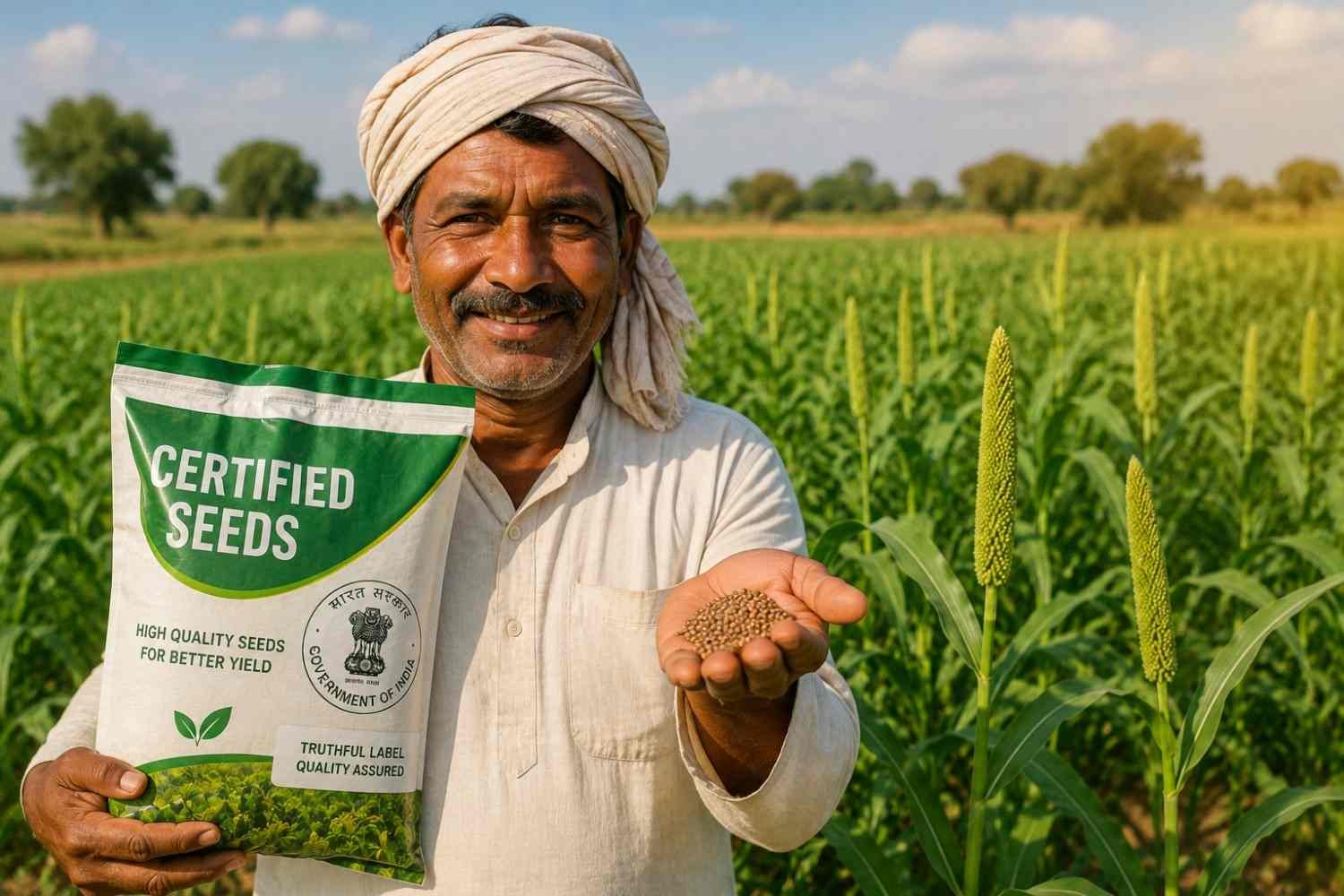
Certified Seeds in India (2026) – Benefits, Types & Selection Guide
Introduction
Every farmer knows this pain: you spend money on seeds, prepare the field, sow with hope — and then the crop fails to give a good yield. Most of the time, the real reason is not the soil or the weather. It is the seed.
In India, many farmers buy seeds from local sellers without checking quality, purity, or how well the seeds will grow. This one mistake can cost an entire season's income.
Certified seeds solve this problem. Certified seeds are tested and approved by government agencies before reaching farmers. They provide better germination, stronger plants, improved disease resistance, and higher crop yield.
This guide explains certified seeds, their types, benefits, and how to choose them. It also covers hybrid comparison, identification tips, and best seeds for Rajasthan conditions. By the end, you will know exactly how to choose the right seed for maximum yield.
Table of Contents
- What Are Certified Seeds
- Types of Certified Seeds (Breeder, Foundation, Certified)
- Benefits of Certified Seeds for Farmers
- Certified Seeds vs Hybrid Seeds
- How to Identify Government Certified Seeds
- Best Certified Seeds for Rajasthan Farmers
- How to Choose the Right Seeds for Maximum Yield
- Frequently Asked Questions
What Are Certified Seeds
Certified seeds pass strict quality checks by authorized seed certification agencies. Agencies like State Seed Certification and National Seeds Corporation ensure seed quality.
These seeds are grown under controlled and supervised conditions. Certified seeds are checked at every stage, from mother plant to final packing. They are tested for purity, germination rate, and protection from diseases.
In simple words: a certified seed is a seed you can trust. It comes with a tag that proves it meets government-approved quality standards.
Key features of certified seeds:
- Minimum 85% germination rate (crop-dependent)
- True to the variety name — no mixing with other varieties
- Free from weed seeds and other crop seeds
- Tested for seed-borne diseases
- Sold in tagged, sealed bags with batch details
This is different from seeds saved at home or bought loose in the local mandi, where there is no quality guarantee at all.
Types of Certified Seeds (Breeder, Foundation, Certified)
Seed production in India follows a chain system. Each stage builds on the one before it, and quality is checked at every level.
1. Breeder Seed
This is the starting point. Breeder seeds are developed by agricultural scientists at research institutes like ICAR. It is the purest form of the seed, produced in very small quantities under strict scientific supervision.
2. Foundation Seed
Foundation seed is grown from breeder seed. It is produced by seed companies and certified agencies to ensure high quality. These seeds maintain the same genetic purity as breeder seeds for better performance. They are produced in large quantities so farmers can easily use them. This stage acts as a bridge between research and farming.
3. Certified Seed
Certified seed is the final stage, grown from foundation seed by registered seed growers. This is the seed that actually reaches farmers. It is produced in bulk, tested by certification agencies, and sold with an official certification tag.
Why does this chain matter to you as a farmer?
Because it means the seed you buy has a traceable, quality-controlled history — not a random bag from an unknown source. This chain is the reason certified seeds perform consistently, season after season.
Benefits of Certified Seeds for Farmers
The benefits of certified seeds go far beyond just "good quality." Here is what farmers actually gain in the field:
- Higher germination rate — fewer gaps in the field, better plant population
- Higher and more consistent yield compared to uncertified or farm-saved seeds
- Better disease resistance, since seeds are tested and treated
- True-to-type crop — no surprise mixing of varieties in the field
- Better uniformity in plant height, flowering, and maturity, which makes harvesting easier
- Long-term cost savings Certified seeds may cost more at first, but they give better results. Higher yield from these seeds helps farmers recover the extra cost easily.
- Reduced risk of crop failure due to weak or contaminated seed
A real example: many Rajasthan farmers who switched from local bajra seed to certified varieties reported noticeably fuller ears and better drought tolerance in the same rainfall conditions. This is the practical difference certified seed selection can make.
If you are looking for region-tested options, checking the best wheat seeds in Rajasthan before the next sowing season is a smart first step.
Certified Seeds vs Hybrid Seeds
Farmers often confuse certified seeds with hybrid seeds. They are not the same thing, and understanding the difference is important for making the right choice.
|
Feature |
Certified Seeds |
Hybrid Seeds |
|
Definition |
Seeds verified for genetic purity and quality by certification agencies |
Seeds produced by crossing two different parent varieties |
|
Seed Saving |
Can be saved and reused for a few seasons with proper care |
Cannot be saved; yield drops in next generation |
|
Yield |
Good and stable yield |
Higher yield in first generation |
|
Cost |
Moderate cost |
Generally higher cost |
|
Purity |
Genetically pure and true-to-type |
Genetically mixed (F1 generation) |
|
Availability |
Available through government and private agencies |
Mainly available through private seed companies |
|
Best For |
Farmers wanting stability and lower repeat cost |
Farmers wanting maximum output in one season |
Many progressive farmers actually use both — certified seeds for staple crops like wheat and gram, and hybrid seeds for crops like mustard where hybrid vigor gives a strong yield boost. For instance, exploring hybrid mustard seeds alongside certified staple crop seeds can balance yield and cost across your farm.
How to Identify Government Certified Seeds
Fake and mislabeled seed bags are a real problem in the market. Here is how to check if the seed you are buying is genuinely certified:
- Check the certification tag — Genuine certified seed bags carry a tag (often blue for foundation, or the certification agency's tag for certified seed) with a unique lot number.
- Look for the agency seal — The tag should mention the name of the State Seed Certification Agency or an authorized body.
- Verify the batch and lot number — This number should be printed clearly and should match the seller's records.
- Check germination percentage and date of testing printed on the tag.
- Buy from authorized dealers only — Avoid loose, unbranded seed sold without any packaging or documentation.
- Ask for the bill/invoice — A genuine dealer will always give a proper bill mentioning the seed variety and batch.
If a seller cannot show you a certification tag or refuses to give a bill, that is a warning sign. Walk away and buy from a trusted source instead.
Best Certified Seeds for Rajasthan Farmers
Rajasthan has low rainfall, sandy soil, and high temperatures affecting farming conditions. These tough conditions require strong and suitable seed varieties for better crop growth. Choosing the right certified seeds helps farmers achieve better yield and stronger harvest.
Recommended crop categories for Rajasthan:
- Moong (Green Gram): A short-duration, water-efficient crop that fits well in Rajasthan's kharif rotation. Farmers seeking better returns often move toward high yield moong seeds with disease-resistant traits.
- Guar (Cluster Bean): Certified guar seed varieties suited to sandy soils are popular in western Rajasthan.
- Wheat and Gram: In irrigated belts, certified wheat and gram seeds remain the backbone of stable rabi income.
- Barley (Jau): Barley seeds perform well in dry areas and provide stable yield with less water.
Always match the seed variety to your specific district's rainfall, soil type, and irrigation availability — not just the crop name.
How to Choose the Right Seeds for Maximum Yield
Seed quality selection is not just about buying "certified" — it is about buying the right certified seed for your land. Follow this checklist:
- Know your soil type — sandy, loamy, or clay soil supports different varieties differently.
- Match the seed to your local climate — check days-to-maturity and drought or heat tolerance ratings.
- Check the germination percentage on the seed tag before purchase — aim for 85% or higher.
- Choose disease-resistant varieties if your area has a history of specific crop diseases.
- Consider water availability — rainfed areas need drought-tolerant certified varieties; irrigated land has more flexibility.
- Buy only from authorized, trusted dealers with proper certification tags and billing.
- Do a small trial on a portion of your land before switching your entire field to a new variety.
- Time your sowing correctly — even the best certified seed underperforms if sown too early or too late for the season.
Farmers who follow this process every season achieve better yield and consistent results. Those who ignore proper methods often get average production and less profit.
Conclusion & Call to Action
Certified seeds are not just a purchase — they are an investment in your entire season's income. From breeder seed to the certified bag in your hand, every stage is built to give you predictable, higher yields and lower risk.
If you are ready to move away from uncertain local seed and start your season with confidence, Agri Raise Crop Care Pvt. Ltd. is here to help. As a trusted certified seed supplier in India, we provide government-certified, lab-tested seeds for bajra, moong, mustard, guar, wheat, and more — specially selected for Rajasthan's soil and climate conditions.
Visit your nearest Agri Raise Crop Care Pvt. Ltd. store today, or contact us to find the right certified seed for your farm and get the best harvest this season.
Frequently Asked Questions (FAQs)
- What is meant by certified seeds?
Certified seeds are government-approved seeds tested for quality, purity, and better crop performance. - Who certifies seeds in India?
Seeds in India are certified by government agencies like State Seed Certification Agencies. - What is the difference between certified seed and foundation seed?
Foundation seeds are basic seeds, while certified seeds are final seeds for farmers. - What are the four classes of certified seed?
Four seed classes are breeder, foundation, registered, and certified seeds for farming use. - What is the difference between registered seed and certified seed?
Registered seeds are intermediate, while certified seeds are final seeds used by farmers. - Which company is best for seeds in India?
Agri Raise provides high-quality certified seeds trusted by farmers across India.

Leave a comment


Comments(0)