
Blog
What Are Certified Seeds? Definition, Classes & Standards
Introduction
Every farming season starts with one big decision: which seed to sow. Yet many Indian farmers still face the same problem year after year — low yield, weak plants, poor germination, and crops that fall sick easily.
In most cases, the real reason behind this is not the soil or the weather. It is the seed quality.
When farmers use seeds saved from last year's harvest or buy seeds from unknown sources, they often get mixed results. Some seeds don't germinate at all. Others grow into plants that are weak or give a low yield.
This is where certified seeds in India come in. Certified seeds are tested, verified, and approved seeds that guarantee better quality, higher germination, and higher yield. In this guide, we will explain in simple language what certified seeds are, why they matter, and how you can identify genuine certified seeds before you buy.
What Are Certified Seeds?
Certified seeds meaning: Certified seeds are seeds that have been grown, inspected, and tested under strict government-approved standards to ensure they are pure, healthy, and true to their variety.
In simple words, certified seeds are seeds that come with a "quality guarantee." Before they reach a farmer's hand, these seeds go through:
- Field inspection (checking the crop while it is growing)
- Laboratory testing (checking purity, germination, and moisture)
- Official approval by a certification agency
Only after passing all these checks, the seed is allowed to be sold as a "certified seed" with an official tag.
So, when you ask "what are certified seeds", the simplest answer is: seeds that are proven to grow into healthy, high-yielding, disease-resistant plants because they have been checked and approved by seed certification authorities.
Why Seed Quality Matters in Farming
The seed is the foundation of the entire crop. If the foundation is weak, everything built on top of it — plant health, yield, and profit — becomes weak too.
Here's how seed quality directly affects farming:
- Yield: Poor quality seeds germinate unevenly, leading to gaps in the field and lower output.
- Disease resistance: Low-quality or old seeds may already carry diseases, which spread to the entire crop.
- Uniform growth: Good seeds grow at the same speed, making harvesting and management easier.
- Profit: A healthy, uniform crop fetches a better price in the market compared to a mixed, weak crop.
This is why experienced farmers, agri students, and seed distributors always recommend starting with good seeds — and the safest way to ensure that is by choosing certified seeds.
Classes of Seeds in India
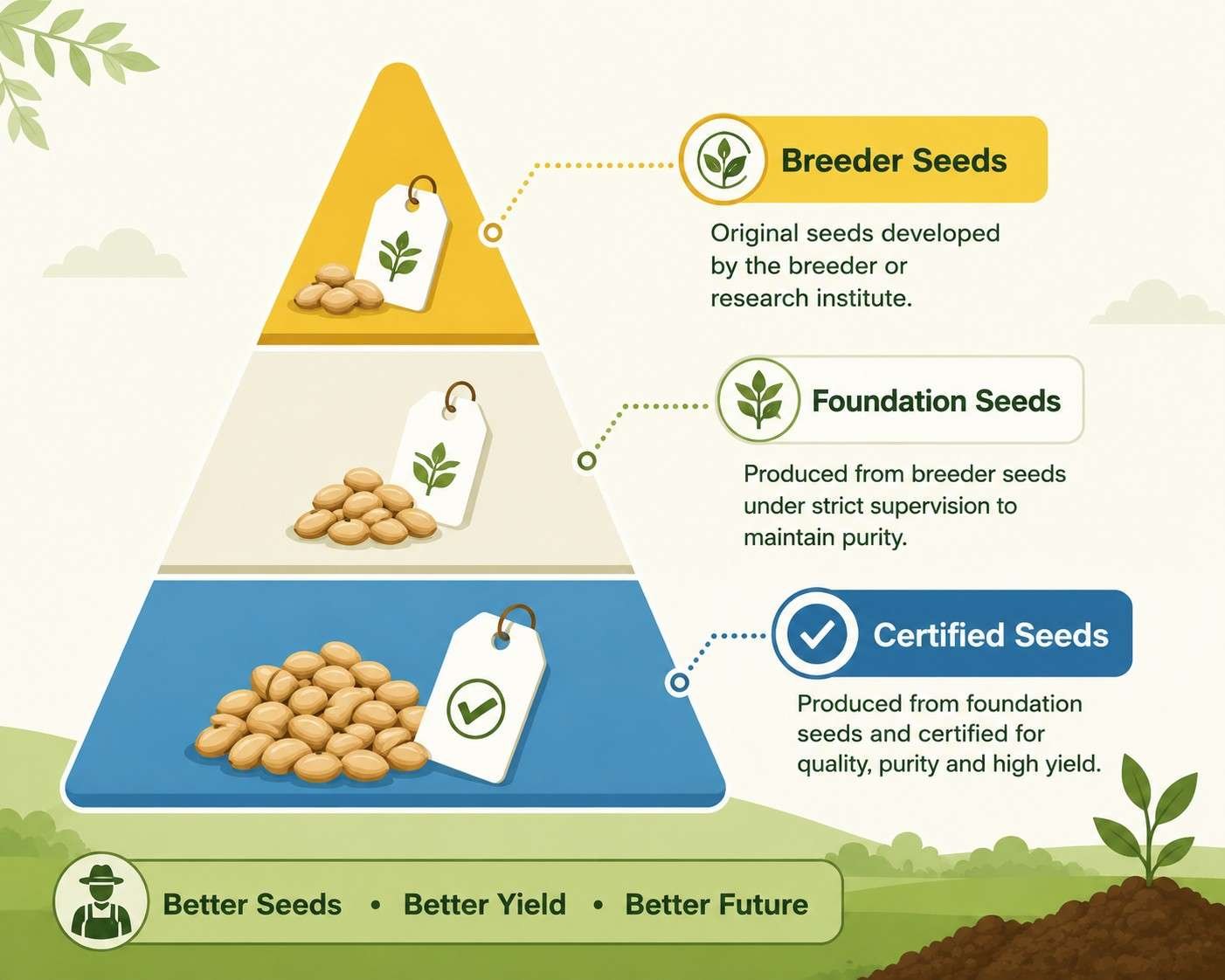
In India, seed production follows a step-by-step system to maintain quality. This system has three main classes: Breeder Seeds → Foundation Seeds → Certified Seeds. Think of it like a pyramid — quality and purity are controlled carefully at every stage.
Breeder Seeds
Breeder seeds are the very first seeds, produced directly by plant breeders or agricultural scientists. These seeds have the highest genetic purity and are the original source of a particular crop variety.
- Produced in very small quantities
- Directly supervised by breeders/scientists
- Used only to produce Foundation seeds
- Identified with a yellow tag
Foundation Seeds
Foundation seeds are grown from breeder seeds. They are produced by government agencies, agricultural universities, or approved seed companies under strict supervision.
- Maintains almost the same purity as breeder seeds
- Produced in larger quantities than breeder seeds
- Used to produce certified seeds
- Identified with a white tag
Certified Seeds
Certified seeds are grown from foundation seeds and are the seeds that finally reach farmers. They go through field inspection and lab testing before certification.
- Produced in large quantities for commercial farming
- Meets minimum standards for purity, germination, and health
- Sold to farmers through seed companies and dealers
- Identified with a blue tag
This is the seed class most Indian farmers should look for when buying seeds for their fields.
Seed Certification Process in India
The seed certification process in India is managed by State Seed Certification Agencies, under guidelines set by the central government. Here is how the process generally works:
Step 1: Registration of the Crop The seed grower registers the crop with the certification agency before sowing, mentioning the seed class and variety.
Step 2: Field Inspection Officials visit the field at different growth stages to check for:
- Isolation distance from other varieties (to avoid mixing)
- Presence of weeds or off-type plants
- Overall crop health
Step 3: Harvesting Supervision Harvesting is monitored to prevent mixing with other seed lots.
Step 4: Seed Sampling and Lab Testing Samples are sent to a seed testing laboratory to check:
- Genetic purity
- Physical purity
- Germination percentage
- Moisture content
Step 5: Tagging and Certification If the seed lot passes all tests, it receives an official certification tag and is approved for sale.
This entire process ensures that by the time certified seeds reach a farmer, they have already passed multiple rounds of government-backed checks.
Standards of Certified Seeds
For a seed lot to be labeled "certified," it must meet specific quality standards set by seed certification authorities in India:
- Genetic Purity: The seed must be true to its variety, without mixing from other varieties.
- Physical Purity: The seed lot should be free from weed seeds, dust, stones, and other crop seeds.
- Germination Percentage: A minimum germination rate (usually 70–90%, depending on crop) must be achieved.
- Moisture Level: Seeds must have controlled moisture content to prevent fungal growth and ensure longer shelf life.
These standards are what separate certified seeds from ordinary market seeds or farm-saved seeds.
Benefits of Certified Seeds for Farmers
Choosing certified seeds brings real, practical benefits to Indian farmers:
- Higher Yield: Good germination and healthy plants directly translate to more output per acre.
- Uniform Crop Growth: Plants grow at the same pace, making irrigation, spraying, and harvesting easier.
- Disease Resistance: Certified seeds are free from major seed-borne diseases, reducing crop loss.
- Better Market Price: Uniform, healthy produce fetches a better price and is easier to sell in bulk.
- Long-term Savings: Fewer replanting needs and lower pesticide costs due to healthier crops.
Certified vs Farm-Saved Seeds (Brief Comparison)
Many farmers reuse seeds from their previous harvest to save money. While this may reduce cost initially, it often affects quality and yield over time.
|
Factor |
Certified Seeds |
Farm-Saved Seeds |
|
Genetic Purity |
High (tested) |
Uncertain, may mix over generations |
|
Germination Rate |
Guaranteed minimum % |
Not guaranteed |
|
Disease Risk |
Low |
Higher risk |
|
Yield |
Consistent, higher |
Often declines over years |
|
Cost |
Slightly higher upfront |
Lower upfront |
If you want to understand this comparison in more detail, read our guide on certified seeds vs uncertified seeds.
How Farmers Can Identify Certified Seeds
Not every seed sold in the market is certified. Here's how you can identify genuine certified seeds before buying:
- Check the Certification Tag: Genuine certified seed bags carry an official tag with details like variety name, lot number, germination %, and validity date.
- Look at the Label Color: Blue tags indicate certified seeds, white tags indicate foundation seeds, and yellow tags indicate breeder seeds.
- Buy from a Trusted Supplier: Always purchase from reputed, registered seed companies or dealers. Companies like Agri Raise Crop Care Pvt. Ltd. are known for supplying properly certified, quality-tested seeds to farmers across India, making them a reliable choice for both small and large growers.
- Verify the Seal: Make sure the bag is properly sealed and not tampered with or repacked.
Conclusion
Good farming starts with a good seed. Certified seeds may cost a little more than ordinary seeds, but the returns they offer — higher yield, healthier crops, and better market price — make them a smart investment, not an extra expense.
If you want to protect your hard work in the field and get the best possible harvest, always choose certified seeds from a trusted supplier. It is one of the simplest decisions that can make a big difference to your farm's productivity and profit.
Frequently Asked Questions (FAQs)
- What is the definition of certified seed?
Certified seeds are high-quality seeds tested and approved by official authorities to meet standard quality requirements.
- What are the four classes of certified seed?
The four main classes are Breeder Seed, Foundation Seed, Registered Seed, and Certified Seed.
- What are the general standards for seed certification?
Seed certification standards include genetic purity, germination rate, physical purity, and disease-free quality.
- What are the five classes of seeds?
The five classes are Nucleus Seed, Breeder Seed, Foundation Seed, Registered Seed, and Certified Seed.
- How is seed certified?
Seeds are certified through field inspection, seed testing, and quality verification by certification agencies.
- What is a simple definition of a seed?
A seed is a small plant embryo that can grow into a new plant under proper conditions.
Ready to boost your farm's productivity?
Always Choose certified seeds in India from a trusted source and give your crops the best possible start this season.

Leave a comment


Comments(0)